
GEA presents a smart decanter at IFAT 2026
- Bild-Infos
- Download
- 3 weitere Medieninhalte
Duesseldorf (Germany), May 5, 2026 – Wastewater treatment in sewage treatment plants is considered critical infrastructure, as it plays a crucial role in protecting communities and ecosystems. At the leading trade fair IFAT 2026 in Munich, solutions provider GEA presented an advancement in the performance capabilities of the GEA OptiPartner® Intellicant® system for intelligent wastewater management. Thanks to Intellicant, the decanter is able to monitor its own process, understand what is happening in real time, and continuously adapt.
GEA presents a smart decanter
Duesseldorf (Germany), May 5, 2026 – Wastewater treatment in sewage treatment plants is considered critical infrastructure, as it plays a crucial role in protecting communities and ecosystems. At the leading trade fair IFAT 2026 in Munich, solutions provider GEA presented an advancement in the performance capabilities of the GEA OptiPartner® Intellicant® system for intelligent wastewater management, which was first introduced in 2023. Thanks to Intellicant, the decanter is able to monitor its own process, understand what is happening in real time, and continuously adapt. By combining advanced sensors, real-time data analysis, and autonomous control software, Intellicant transforms a decanter into a self-optimizing system that continuously adapts to changing sewage sludge conditions and keeps the process at its optimal operating point. As a result, this means higher dry substance values, lower polymer consumption, lower costs, less effort, and high process reliability for wastewater treatment plant operators. Intellicant thus demonstrates how digital intelligence can elevate essential infrastructure to a new level of performance and efficiency. Specifically, this also means: Every percentage point of dry matter (DM) can save €135,000 in annual disposal costs (calculation based on a decanter installation in a wastewater treatment plant with a capacity of 385,000 population equivalents and disposal costs of €60/t DM).
Pressure on wastewater treatment plant operators is rising – water is also a significant location factor
The pressure on the operational management of wastewater treatment plants has increased dramatically. One cause is fluctuating sewage sludge properties. The sludge composition is constantly changing. Precipitation, temperatures, industrial discharges, and local events can alter the properties of the feed within minutes. Operators respond by adjusting polymer dosing, drying targets, differential velocity, or tank depth. However, these manual adjustments are always sporadic and always made only after the fact. This is reactive rather than proactive. In today’s world, that is no longer sufficient. Furthermore, the industry is facing a growing shortage of qualified personnel. At the same time, water is becoming a critical production and location factor for the industry. Water stress, rising demand, and necessary investments in infrastructure are already having a noticeable impact on supply chains, production reliability, and competitiveness.
A Digital Leap Forward
In 2023, the machinery and plant manufacturer and solutions provider GEA launched Intellicant—GEA’s algorithm- and cloud-based digital product that transforms a decanter into a self-optimizing system.
Intellicant – The digital brain of GEA’s decanter product line for the environmental sector
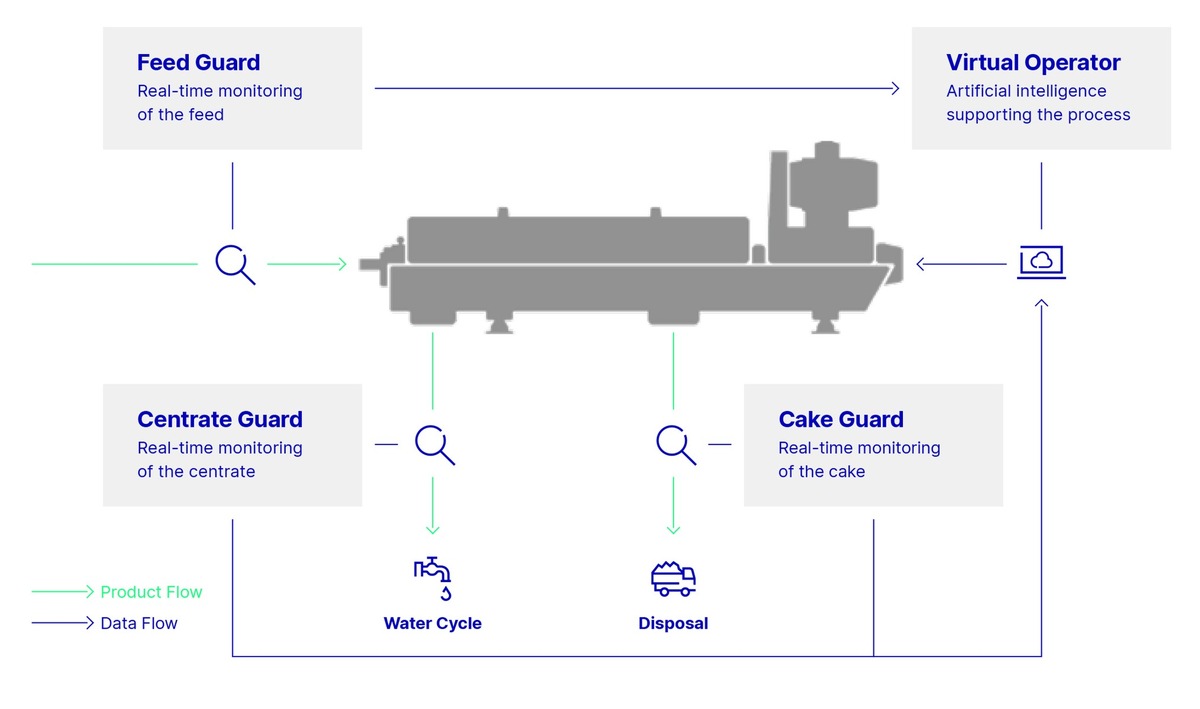
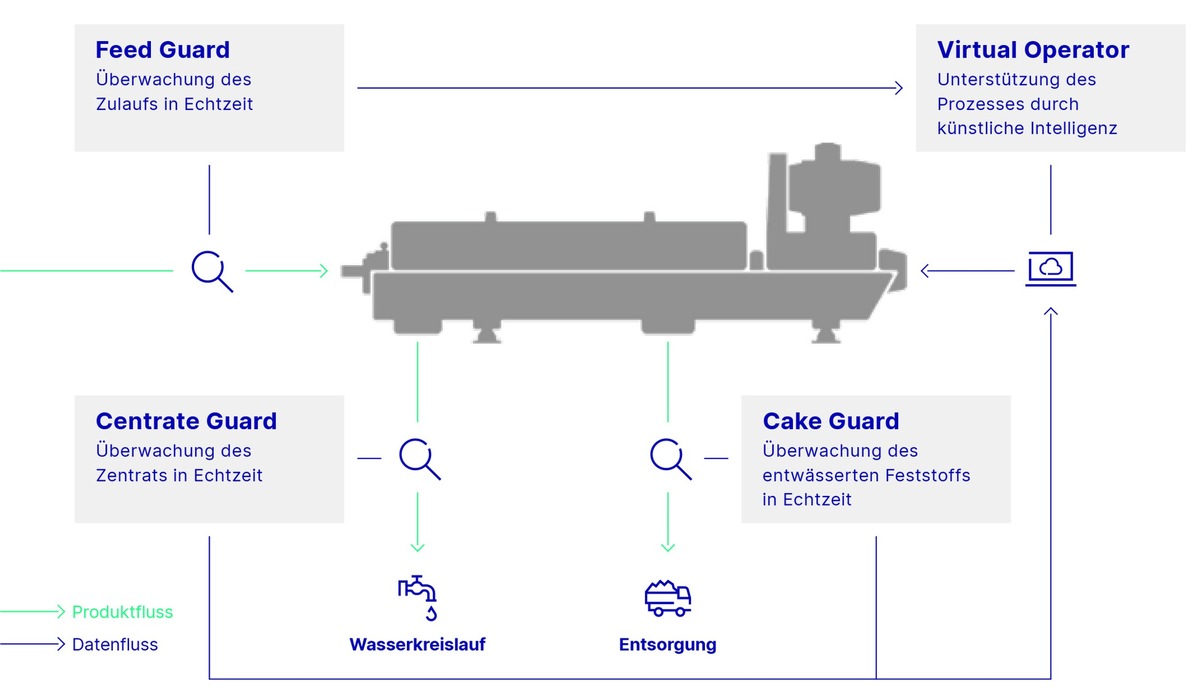
At the heart of Intellicant lies a simple idea: a decanter that can “see” its own process in real time can optimize itself faster and more precisely than any human operator. Intellicant’s compact sensor package continuously measures three critical parameters—solids content in the feed, centrate quality, and cake dryness—thus generating a live data stream from within the process.
Intellicant is available either with a new decanter centrifuge or as a retrofit kit for existing GEA environmental Decanters and combines low-maintenance sensors, autonomous control, and tools for real-time monitoring and reporting. It is offered as a subscription-based digital service that provides continuous optimization, insights, and performance reports.
Intellicant is available in three tailored configurations, each designed to optimize a specific operational priority:
- Core Kit with a focus on process stability
- Automatically controls polymer dosing and stabilizes the process under fluctuating sludge conditions.
- Edge Kit, focused on optimized polymer consumption
- Reduces polymer consumption while maintaining maximum separation performance.
- Peak Kit, focused on maximum dry solids content
- Maximizes the dry solids content of the dewatered sludge, thereby reducing disposal volumes and costs.
How real-time monitoring with GEA OptiPartner® Intellicant® works
Intellicant consists of a sensor package and software, the “Virtual Operator.” The sensors monitor three critical process parameters in real time: the solids concentration of the feed, the turbidity of the centrate, and the dry solids content of the solids in the discharge. This sensor data is transmitted to the Virtual Operator via a local network connection. The software is integrated into the decanter’s existing plant control system and reacts automatically and intelligently to the incoming data.
Volume of sewage sludge increased compared to the previous year
While the volume of sewage sludge produced and disposed of had declined every year since 2021, it rose again in 2024. Across Germany, municipal wastewater treatment plants reported a total increase of 2% in sewage sludge production and disposal in 2024 compared to 2023. This increase in volume is roughly equivalent to the sewage sludge output of a city with a population of one million.
Sewage Sludge in Agriculture
Less and less sewage sludge is being used as fertilizer in agriculture in Germany: In 2024, municipal wastewater treatment plants disposed of approximately 1.67 million tons of sewage sludge. Only 12% of this (0.20 million tons) was applied to agricultural land. By comparison: In 2009, 30% of sewage sludge was still being used as fertilizer in agriculture. As the Federal Statistical Office (Destatis) further reports, the share of sewage sludge thermally utilized rose to 82% in 2024, whereas the share had been 53% in 2009. This means that in 2024, approximately 1.37 million tons of sewage sludge were incinerated and used, among other things, for energy and heat generation. About 80,000 tons (5%) were disposed of through other means. Approximately 13,000 tons (1%) of sewage sludge were used in landscaping.
Customer Reports
Lower polymer consumption, consistently high performance (Oldenburg, Germany)
At the Oldenburg wastewater treatment plant, operators face a daily balancing act that most people never see: They must maintain separation efficiency high enough to protect the entire plant from overload, comply with strict ammonium limits that protect local waterways, and do all this with minimal polymer consumption and within budget. It is a task that requires constant vigilance and in-depth expertise.
Intellicant stepped in exactly where the pressure was greatest. By stabilizing the process and taking over the most demanding aspects of decanter control, it gave operators the much-needed time, clarity, and assurance that the system would remain stable even under changing sludge conditions.
The economic benefits were significant. Using the Intellicant Edge Kit, the plant achieved an 11% reduction in polymer consumption during a two-month trial—without compromising stability. With an annual polymer consumption of around 100 tons, this translates to a substantial financial gain. A payback period of just 1.5 to 2 years made the decision to implement the system an easy one.
[QUOTE]
“We reduced polymer consumption by 11% while maintaining stable separation performance. With 100 tons of polymer per year, this is a major financial gain.” — Ronald Chritonenkov, Plant Coordinator, Oldenburg Wastewater Treatment Plant
Precise dosing and significant savings (Geseke, Germany)
Before introducing Intellicant, operators at the Geseke wastewater treatment plant often dosed too much polymer to be on the safe side—a necessary but imperfect solution in a process where stability protects both the plant and the environment. Intellicant has completely changed this dynamic.
Polymer consumption dropped by 25–28%, yet the process became more stable than ever. Operators gained time to focus on the rest of the plant instead of constantly chasing after the decanter. And the data Intellicant delivers daily has become a strategic advantage.
“Historical data is worth its weight in gold,” says Westermann. With transparent, reliable data, the team can finally track how the process behaves over time, make informed decisions, and see the impact of their adjustments. The downstream biological treatment runs more smoothly, and the entire plant operates in a more controlled, efficient, and resilient manner.
[QUOTE]
“We’re saving between 25 and 28% on polymer—and the dewatering process remains stable. Furthermore, the historical data provided by Intellicant has become one of our most valuable assets.” — Wilfried Westermann, Manager of the Geseke Wastewater Treatment Plant
Higher solids content, fewer trucks, lower costs (Borsdorf, Germany)
At the Parthe wastewater treatment plant in Borsdorf—which serves six municipalities and parts of Leipzig—Intellicant (Peak Kit) has become a proven part of daily operations. The system runs reliably around the clock and responds immediately to changes that operating personnel simply cannot monitor continuously. The solids content rose from 22% to a stable 24%—which corresponds to an increase in actual solids content of about 10%. This small numerical shift has significant practical implications: fewer truckloads, lower transport frequency, and reduced disposal costs. What used to require nearly daily pickups now requires only three per week. For operators like Tom Höhnel, the difference is personally noticeable. He starts every day by turning on the decanter—and then Intellicant—because it makes his work easier and frees him up to focus on the rest of the plant. Even with staff shortages, the plant can maintain safe, stable dewatering and ensure compliant discharge into the Parthe River.
NOTES TO THE EDITOR
- More information about GEA
- To the GEA Media Center
- Follow GEA on LinkedIn, Youtube
Contact Media Relations
GEA Group Aktiengesellschaft
Michael Golek
Ulmenstr. 99, 40476 Düsseldorf, Germany
Phone +49 211 9136-1505
 michael.golek@gea.com
About GEA
GEA is one of the world’s largest suppliers of systems and components to the food, beverage and pharmaceutical industries. The international technology group, founded in 1881, focuses on machinery and plants, as well as advanced process technology, components and comprehensive services. For instance, every second pharma separator for essential healthcare products such as vaccines or novel biopharmaceuticals is produced by GEA. In food, every fourth package of pasta or every third chicken nugget are processed with GEA technology.
With more than 18,000 employees, the group generated revenues of about EUR 5.5 billion in more than 150 countries in fiscal year 2025. GEA plants, processes, components and services enhance the efficiency and sustainability of customers’ production. They contribute significantly to the reduction of CO2 emissions, plastic usage and food waste. In doing so, GEA makes a key contribution toward a sustainable future, in line with the company’s purpose: ”Engineering for a better world.”
GEA is listed on the DAX, the STOXX® Europe 600 Index and is also a constituent of the leading sustainability indices DAX 50 ESG, MSCI Global Sustainability and Dow Jones Best-in-Class World.
More information can be found online at gea.com.
If you do not want to receive any further information from GEA, please send an e-mail to pr@gea.com.
About the GEA Foundation
The GEA Foundation, established in 2025 by GEA Group, supports global and local projects in STEM education, child poverty reduction, infrastructure access and disaster relief. Through its Mission 30 strategy, GEA commits to donating one percent of annual net profit to build resilient communities.
More information can be found online at gea.com/foundation.
Further material to download

document:  2026.05.05_GEA-Intellicant-e.docx

document:  2026.05.05_GEA-Intellicant-d.docx