

Former NATO Secretary General Rasmussen proposes Democracies-7-Group as "the new leader of the free world"
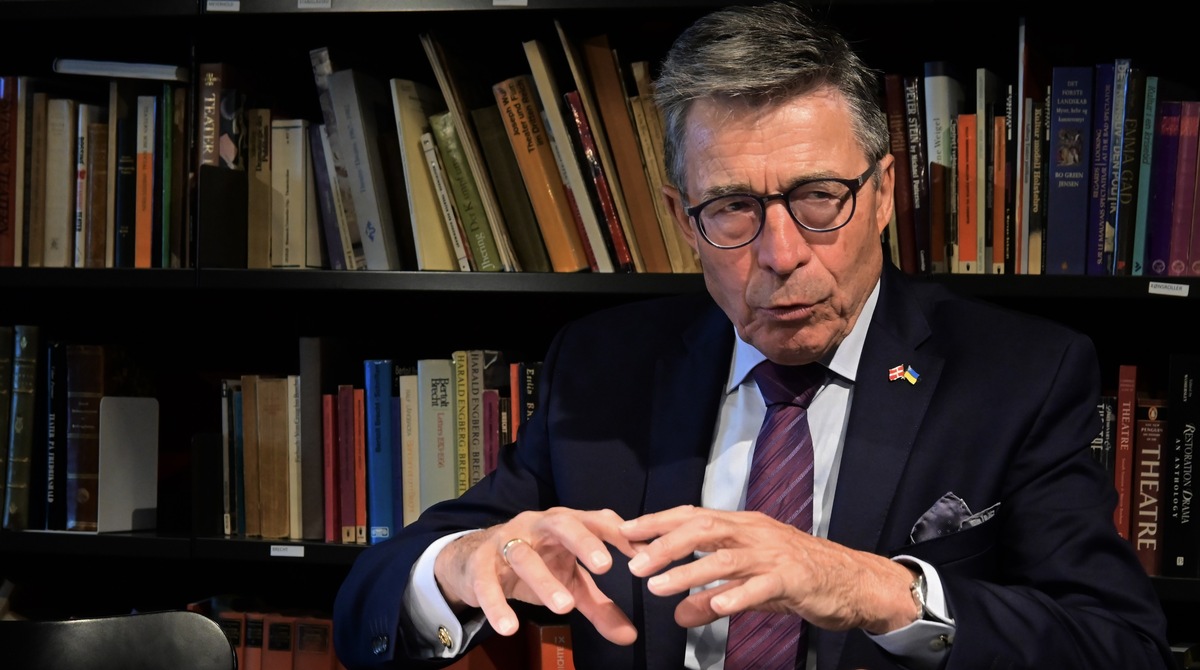
- Bild-Infos
- Download
Copenhagen/DNA (ots)
Anders Fogh Rasmussen was Prime Minister of Denmark (2001-2009) and Secretary General of NATO (2009-2014). Today, Rasmussen, 73, works as a political adviser and heads the Alliance of Democracies Foundation, which organises the Copenhagen Democracy Summit once a year.
One day before the 2026 Copenhagen Democracy Summit on May 12, Rasmussen went public with a proposal to establish an alliance of democratic countries, which he would like to call the D7. According to his proposal, the group should include Australia, New Zealand, Canada, the European Union, Japan, South Korea and the United Kingdom.
In an interview with the Democracy News Alliance, Rasmussen explains what he hopes to achieve with his D7 idea, where he sees the major threats to democracy worldwide, and what he envisages the world should look like in five years' time.
Question: Mr. Rasmussen, democracy around the world is under more pressure than it has been for decades. What is your greatest concern at the moment? Is it the conduct of the United States of America?
Rasmussen: Well, the US is a challenge, but I still think the main threat stems from the world's autocrats. Xi Jinping in China, Putin in Russia, the priests in Tehran, etc. This axis of autocrats still represents the biggest threat. But obviously... my main concern right now is the unpredictable behaviour of the Trump administration.
Question: Is it more external influences and threats that are weighing on democracy in individual countries? Or is it more internal shifts toward a greater populist extremism, that have pushed democracy onto the defence in so many countries?
Rasmussen: It is first and foremost the external threats. For the 20th consecutive year, we have now seen a decline in global freedom and democracy. And in concrete terms, a democratic country, Ukraine, is threatened from an autocratic country, Russia. A democratic country, Taiwan, is threatened from an autocratic country, China. In the Middle East, a democratic country, Israel, is threatened by an autocratic country, Iran. So the external threats are the predominant threats.
But, obviously, we also have to address the internal dissatisfaction in many democratic countries. People don't think that democratically elected leaders address their main concerns, like, for instance, immigration. And we really have to address those issues appropriately. Unless we do that, the extremists on both the right and the left side of the political spectrum will further advance.
Question: Your proposal for an answer to all these problems is the D7 initiative which you are presenting here in Copenhagen. What exactly is this alliance meant to achieve?
Rasmussen: The D7, Democracy 7, is meant to be the new leader of the free world. Since childhood, I have admired the US and considered the United States a natural leader of the free world. But it appears that President Trump has retired from that role. So, we need a new leader of the free world, and that's why I suggest that seven countries and entities in the world gather and create a core, a democratic core. The seven countries represent 30% of the global economy. And if we act together, if we join forces, act collectively, then we represent a formidable force.
That will create respect in Beijing, or for that sake in Washington, if we are exposed to economic coercion, and if we respond to that collectively, then we represent a strong and really needed force against the advancing autocracies. So this is the reason why I suggest the D7. Let me stress, it shouldn't be a closed club. I would welcome everybody in the world who shares the view that the world's democracies should work closer together to counter the advancing autocracies.
Question: D7 surely does not coincidentally echo the G7. Has the G7 had its day?
Rasmussen: Yes, you might say that G7 was created in the old world. But now we are approaching a new world order in which D7 is the tool in which the democratic middle powers of the world unite. I use the term middle powers because Prime Minister Carney of Canada used it in his Davos speech. And he's been, I would say, a driving force, travelling to a number of the countries I mentioned in the D7 alliance. That's also why I suggest that he should become the first leader of the rotating presidency of D7. So I think in a strongman world, where the big powers try to dominate the world and take decisions over the head of the middle powers, D7 is the most efficient instrument to ensure democratic resilience.
Question: Have you spoken to Prime Minister Carney about this initiative? And if yes, what was his reaction?
Rasmussen: No, I haven't spoken to him personally, but (...) we will have a Canadian representative on stage, Chrystia Freeland, who is a former Deputy Prime Minister of Canada - and by the way, also a former Foreign Minister of Japan, Kono - to hear their initial reaction to this idea that would include Canada and Japan alongside the European Union, the UK, Australia, New Zealand and South Korea.
Question: Have you tested the waters with leaders from all these countries and entities, and how do they react on the D7 initiative?
Rasmussen: Well, basically positive, but also in a reflexion mode. As an example, I spoke with Japanese leaders who on the one hand realise the importance of Japan engaging more with other countries in the world. On the other hand, they don't want to scrap the coalition with the United States. I really understand that. And it's important for me to stress that this is not anti-US or anti-China. It's first and foremost pro-democracy. It's pro-free trade. It's pro what I would call a technological alliance in which you establish international norms and standards for the use of new technology.
It's a critical raw coalition, where we help each other to reduce our dependency on other countries to ensure a strong value chain when it comes to delivery of critical raw materials. And it is also an investment alliance in which we jointly invest in the Global South to create an alternative to the Chinese Belt and Road Initiative. And I also suggest to introduce what I call an economic Article 5, modelled on the famous NATO Article 5 where we consider an attack on one an attack on all. We should act exact the same way when it comes to economics. If the Chinese single out and try to punish an individual member of the Alliance D7, then we should respond collectively.
Question: How important is this trade policy element of your initiative in comparison to a joint understanding of democracy, which is the basis? Using the EU-Mercosur agreement as an example, we have seen how long it can take and what hurdles need to be cleared before such a joint trade policy can be implemented.
Rasmussen: Yes, but it also shows that when you come under pressure, then you can act quickly. And I would use it as an example that D7 should not be a closed club. On the contrary, we should engage with other countries in concluding free trade agreements. Mercosur is an excellent example. Another example is India. And the EU has now, after many years of negotiations, also concluded a free trade agreement with Australia. It shows that there is a strong desire among the world's democracies to stand up against Trump, China, Putin, and other autocrats that expose us to military or economic political coercion.
Question: But how realistic is this initiative at the moment? What time do you think the D7 as an instrument could be implemented?
Rasmussen: Well, I would be hesitant to set exact timelines, but in the 70s, G7 developed gradually, and I think D7 could develop exactly the same way on the sidelines of international meetings. Those seven democracies could meet and gradually develop a cooperation. It should be a light cooperation without heavy bureaucracy. I could imagine that heads of state and government meet once a year. You have regular meetings at foreign and finance minister level, etc., and a very small secretariat. So it should be an agile entity.
Question: What would be your desired scenario for the global state of democracy one year from today? And what does the scenario look like that you actually consider realistic one year from now?
Rasmussen: One year, that's a short time horizon, and you may not be able to see significant progress in one year's time. But if you say, how do I see the prospects of global freedom and democracy in five years time? And the ideal scenario would be to see an autocratic Russia and autocratic China on the retreat, it would be to see a new political leadership in the United States committed to strong transatlantic cooperation, realising that if you want to make the United States great, then you need allies. And I would argue that the strongest force for freedom and democracy in the world would be a strong alliance between Europe and the United States.
So that's what I would like to see. And obviously within such an alliance, threats against each other would be unacceptable, like the United States' threats against a NATO ally like Denmark threatening to take Greenland by military force. I mean, that kind of behaviour is damaging for the world's democracies. It only serves the purpose of Putin and other autocrats.
Interview: Christian Röwekamp, DNA
---------------
This text and the accompanying material (photos and graphics) are an offer from the Democracy News Alliance, a close co-operation between Agence France-Presse (AFP, France), Agenzia Nazionale Stampa Associata (ANSA, Italy), The Canadian Press (CP, Canada), Deutsche Presse-Agentur (dpa, Germany) and PA Media (PA, UK). All recipients can use this material without the need for a separate subscription agreement with one or more of the participating agencies. This includes the recipient's right to publish the material in own products.
The DNA content is an independent journalistic service that operates separately from the other services of the participating agencies. It is produced by editorial units that are not involved in the production of the agencies' main news services. Nevertheless, the editorial standards of the agencies and their assurance of completely independent, impartial and unbiased reporting also apply here.
Contact:
Democracy News Alliance
Christian Röwekamp
roewekamp.christian@dpa.com
Original-Content von: Democracy News Alliance, übermittelt durch news aktuell