
New Perspectives for Bio-Based and Biodegradable Plastics in Agricultural and Forestry Practice
- Photo Info
- Download
- One additional media item
One document
New Perspectives for Bio-Based and Biodegradable Plastics in Agricultural and Forestry Practice
Specialist workshop of the PerPlacsBio project brings together practitioners, researchers and companies
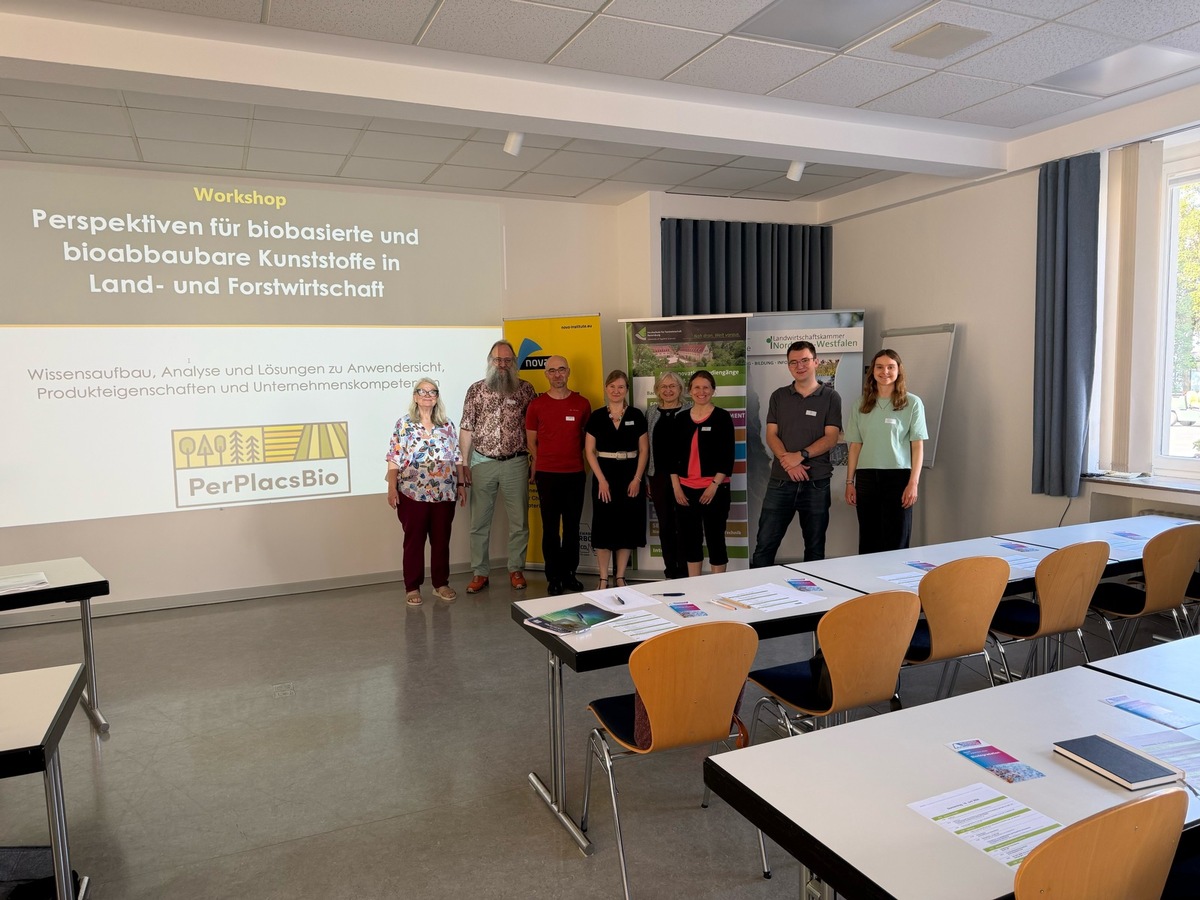
How can plastics be used more sustainably, reduced or replaced by suitable bio-based and/or biodegradable alternatives in agriculture and forestry? This question was at the heart of the workshop “Perspectives for Bio-Based and Biodegradable Plastics in Agriculture and Forestry”, which took place on Thursday, 18 June 2026, at Haus Düsse in Bad Sassendorf, Germany.
The event was organised as part of the PerPlacsBio project and brought together representatives from agriculture, forestry, research, advisory services, companies and other organisations. The objective of the workshop was to consolidate the current state of knowledge, discuss practical challenges and jointly develop perspectives for the use of bio-based and biodegradable plastic solutions.
The workshop focused on the requirements of users, as well as product properties, company expertise and existing and future fields of application. Expert presentations provided insights into the challenges associated with the use and reduction of plastics in agricultural and forestry practice, potential applications for biodegradable plastics, and available solutions and suppliers.
Interdisciplinary Exchange for More Sustainable Use of Plastics
A key element of the workshop was the World Café. At various moderated tables dedicated to different key topics, participants were able to discuss specific applications, product examples and open questions with companies and project partners. The discussions covered, among other things, plastic products and alternatives in areas such as films, fastening systems, protective covers and forestry applications such as tree shelters. Participants included the manufacturers of biodegradable tree shelters Rainbow and Deosend, as well as the companies BASF and FKuR, which presented biodegradable materials for applications such as mulch films and clips. The World Café was complemented by a contribution from the partner project AgriRePlas and by a table showcasing a plant pot based on natural fibres from the company Neisser Geotextilien.
The discussions made it clear that biodegradable plastics can offer significant benefits in agriculture and forestry when suitable regulation, performance, trust and clear information come together. In the field of tree shelters, more than 500,000 biodegradable products have already been sold. Interest in mulch films is also growing, although demand varies depending on the crop and field of application. In the EU, the market volume is around 80,000 tonnes per year; biodegradable mulch films currently account for around 5% of this volume. In China, such solutions are already used at a share of around 10%. It also became clear that a significant market shift is imminent in other areas, such as seed coatings and carrier materials for fertilisers. New regulatory requirements and potential bans on conventional plastics are increasing the pressure on companies to develop and use suitable alternatives, including biodegradable solutions.
ReCaCo: Company Directory for Renewable Carbon Solutions
Many companies producing biodegradable products for agriculture and forestry are already listed in the online directory Renewable Carbon Companies (ReCaCo). ReCaCo brings together companies, raw materials, technologies and products based on renewable carbon – bio-based, CO₂-based or recycling-based. As part of PerPlacsBio, ReCaCo is being specifically expanded to make it easier for end users in agriculture and forestry to access suitable bio-based and biodegradable solutions.
The directory is available via https://renewable-carbon.eu/companies/.
Regulatory and Normative Frameworks Set the Direction
Another item on the programme focused on developments in standardisation. The DIN SPEC 35808 was presented, which addresses the bio-based content and biodegradation of tree shelters under forest-like conditions. It became clear that the degradation rate can vary depending on soil properties and environmental conditions and may take longer in practice than under test conditions. For this reason, the standard comprises two testing concepts: one assesses basic biodegradability, while the other examines degradation under forest-like conditions. While the first test is intended to demonstrate complete biodegradation, the second requires a minimum degradation rate of 10% based on the degradation of pine heartwood. This is intended to ensure that no persistent plastics remain in forest soils in the long term. The presentation highlighted that, alongside technical product solutions, reliable criteria, testing methods and standards play a central role in the assessment and acceptance of biodegradable plastics.
The results of the workshop will feed into the further work of the PerPlacsBio project. The aim is to build knowledge, increase the visibility of existing solutions and support users, companies and other stakeholders in assessing suitable alternatives.
Another opportunity for in-depth exchange will be provided by the Renewable Materials Conference 2026: in the workshop “Rethinking Plastics in Agriculture and Forestry”, experts from the nova-Institute and Hydra Marine Science will provide insights into the role of biodegradable materials in agriculture and forestry and share experiences from the PerPlacsBio and AgriRePlas projects.
Further information: https://renewable-materials.eu.
About the PerPlacsBio project
At the end of 2025, the University of Münster, Rottenburg University of Applied Forest Sciences and the nova-Institute launched the two-year PerPlacsBio project. Funded by the German Agency for Renewable Resources (FNR) under the “Renewable Resources Sustainable” programme, the project aims to examine the prospects for bio-based and biodegradable plastics in agriculture and forestry.
The PerPlacsBio project is funded by the German Federal Ministry of Agriculture, Food and Regional Identity (BMLEH) through the project management agency Fachagentur Nachwachsende Rohstoffe e. V. (FNR) under the funding programme “Sustainable Renewable Resources” under funding number 2224NR022A.
Find all nova press releases, images and more free-for-press material at https://nova-institute.eu/news/pr/
Responsible for the content under German press law (V. i. S. d. P.):
Dr. Lars Börger (CEO)
nova-Institut für politische und ökologische Innovation GmbH
Leyboldstraße 16
50354 Hürth
Germany
Tel: +49 2233 460 14 00
Fax +49 2233 460 14 01
 contact@nova-institut.de
Since the mid-1990s, the nova-Institute has been dedicated to sustainability and today focuses primarily on renewable carbon cycles. As an independent research institute, it supports companies – particularly from the chemical, plastics, and materials industries – in the use of renewable carbon derived from biomass, direct CO₂ utilisation (CCU), and recycling.
With a multidisciplinary team of scientists, the nova-Institute participates in international innovation projects and provides science-based management consulting. The institute follows a holistic approach: its experts analyse which technologies and raw materials are suitable for specific products, in which markets their application is feasible, which regulatory frameworks apply, how sustainable the solutions are, and how they can be successfully positioned in the market.
Based on these analyses, the team develops tailored strategies to support the transformation from fossil to renewable carbon. Around 50 experts from various disciplines work together to drive the defossilisation of industry – for a climate-neutral future.
More information: www.nova-institute.eu – www.renewable-carbon.eu
Subscribe to our newsletter:  https://renewable-carbon.eu/newsletters
Comprehensive reports and free graphics available at:  https://renewable-carbon.eu/publications