
Human reality, not cyborg clichés: representing people with prostheses accurately in AI images
- Photo Info
- Download
- 2 additional media items
Human reality, not cyborg clichés: representing people with prostheses accurately in AI images.
Prosthesis users, Ottobock and Microsoft create an open image library for more authentic AI images.
Wednesday, 22 July 2026
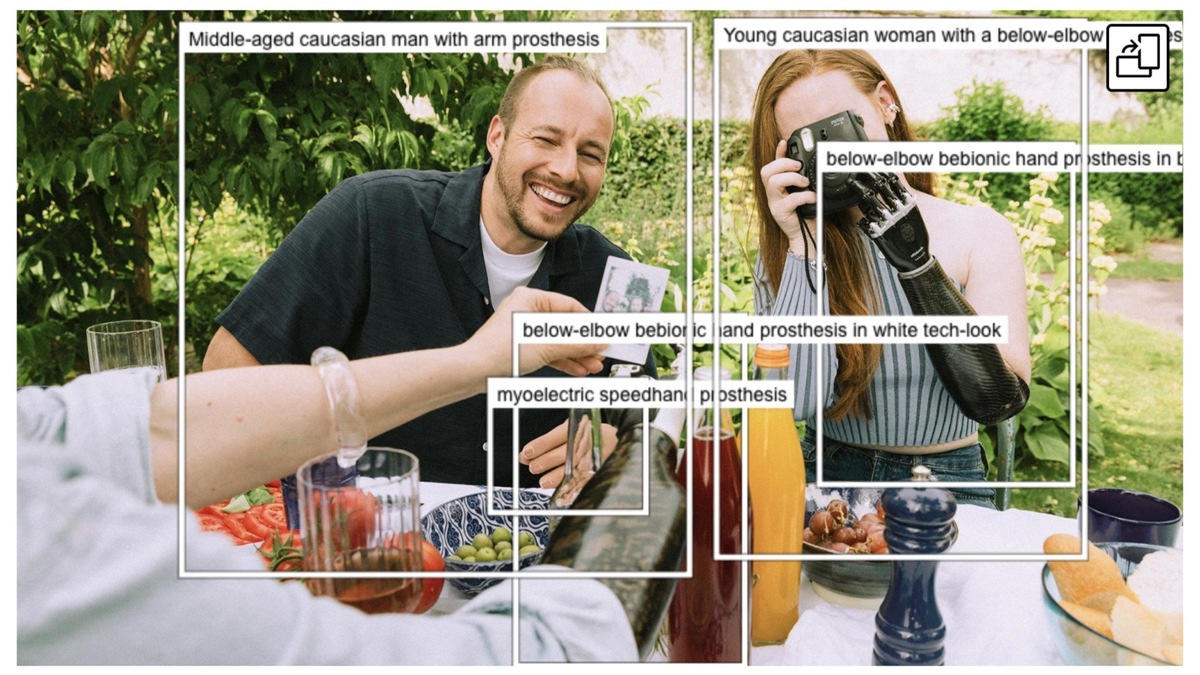
As much as artificial intelligence can achieve, it still frequently struggles in its attempts to represent people with disabilities. Anyone who has tried to use AI to create images of people with prostheses will be familiar with the distorted images they often receive in return: cyborgs, science fiction figures or anatomically incorrect bodies instead of realistic everyday scenes of people in the office, on the playground or engaged in sports activities. This is due to the data used to train AI models, in which people with disabilities are either a rarity or presented from a one-dimensional perspective.
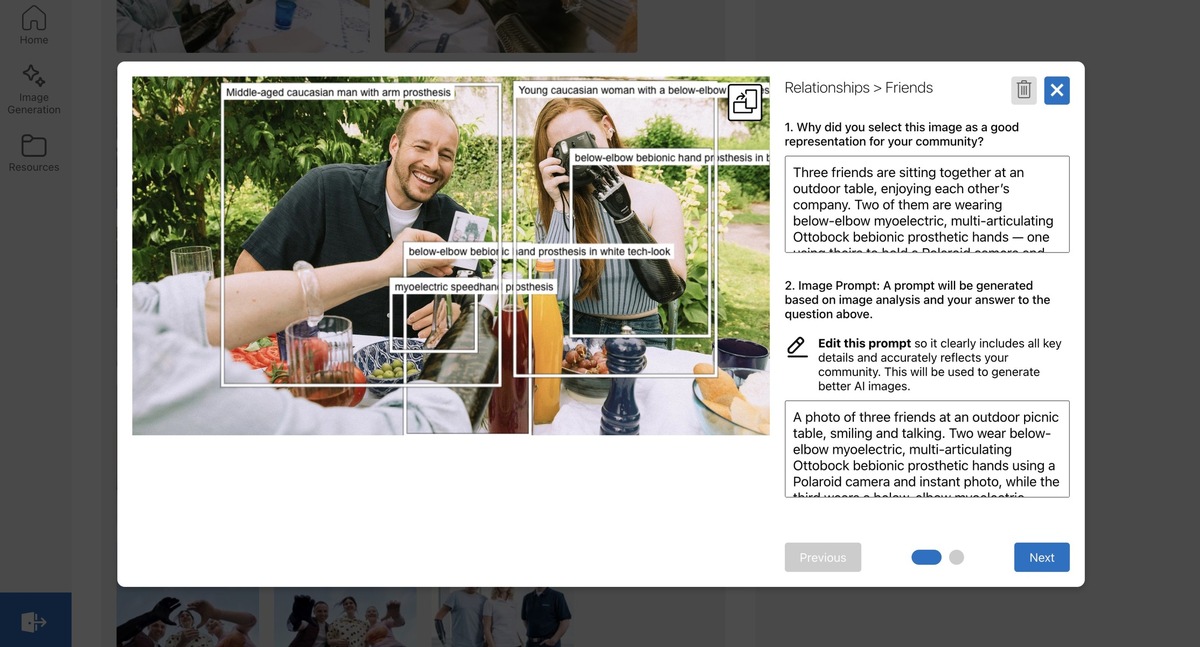
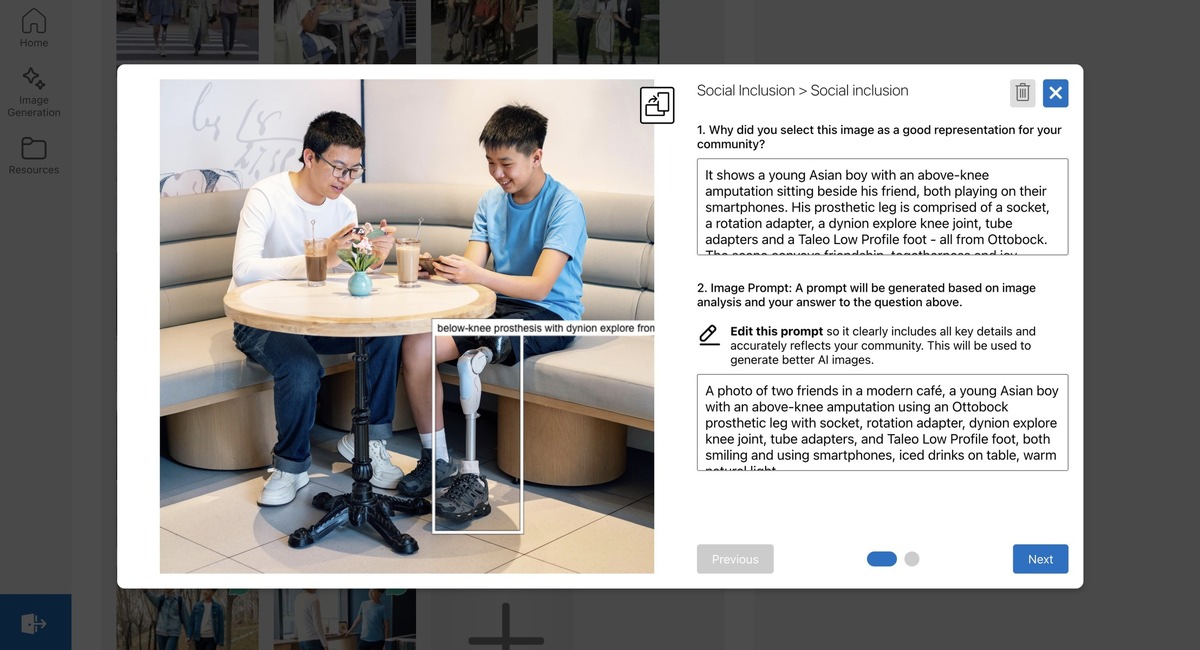
Ottobock wants to close this gap in cooperation with prosthesis users. Today, that is why the company is publishing the #DearAI Community Library: an open-source dataset of images depicting people with arm and leg prostheses in everyday life more realistically, powered by Microsoft.
“For us, it’s not just about creating better AI images. It’s about who will be visible in the digital world of tomorrow – and who won’t”, says Martin Böhm, Chief Experience Officer at Ottobock. “AI is increasingly influencing how people and their lived realities are perceived. That is why diversity must not be lost at the point where representations start to cross into the world of AI data. With the #DearAI Community Library, we are helping to ensure that AI-generated images represent people with disabilities in a natural and authentic way.”
Invisibility in AI images.
A scientific analysis conducted in 2025[i] revealed: across 444 AI-generated images spanning 37 occupations, not a single person with a visible disability appeared. When disability does appear in AI-generated images, nearly 100% of depictions default to a manual wheelchair. The lived realities of people with amputations, congenital arm or leg malformations (dysmelia) and other disabilities remain largely invisible.
The issue is more than one of representation, however. AI-generated images become more prevalent across media, marketing, and daily life. The technology’s reach is enormous: usage figures published by Google[ii] indicate that its Nano Banana models alone have been generating around 200 million images per day in recent times. As a result, AI systems are increasingly influencing which people, professions and realities of life are made visible. Research[iii] confirms that distorted representations can reinforce existing stereotypes and inadequately reflect social diversity.
“Millions of people use AI every day – so the results of the models influence how we see the world”, says Agnes Heftberger, CEO of Microsoft Germany and Austria. “It goes without saying that people with disabilities and amputations need to be included in AI-generated images to give them visibility.” It its Responsible AI Principles, Microsoft has set out its own guidelines on developing and using AI responsibly, reliably and safely. “Inclusivity is essential when it comes to using AI responsibly”, says Heftberger. “We are fully committed to using our technology expertise in a way that enables those affected by this issue to be represented authentically – how they see themselves.”
Showing AI what real life looks like.
Andreas Onea is someone with personal experience of distorted imagery. The Paralympic swimmer, Rio 2016 bronze medal winner and TV presenter lost his left arm in a car accident when he was a child. When people were generating images of themselves as action figures during the start of the AI hype, Onea wanted to jump on the trend – but the AI initially refused to create his image, supposedly because of a content violation. After several attempts, he did manage to generate an image that showed his name, but not his body: the figure had an extra half an arm. “It was very obviously not me”, says Onea.
For him, this experience showed how quickly a lack of representation turns into a lack of participation – and that led him to add his perspective to the development of the Community Library. “If you aren’t visible, you don’t exist”, says Onea. “We want to show AI models that people with disabilities are part of our world and our society. We are involved, we are contributing – and that is exactly what needs to be visible in AI images.”
Training data for more inclusive AI.
The #DearAI Community Library was built on a simple but powerful concept that has been guiding Ottobock’s campaigns: talking to people rather than about them. The company involved an international group of prosthetic users — with upper and lower limb differences. They worked within a platform provided by Microsoft to define criteria for realistic and respectful representations.
More than 60 participants from across the world submitted images and videos, which were then selected and annotated against community-defined standards for AI imagery. The result is two datasets with a total of around 800 AI-interpretable images, one focused on upper limb loss and difference, one on lower limb loss and difference.
The Community Library is the foundation of the #DearAI campaign, in which prosthesis users address AI directly, sharing their lived experiences and everyday realities. They include fencing champion Bebe Vio, mountaineer Hari Budha Magar and high jumper Ezra Frech. Through its new initiative, Ottobock is continuing its commitment to visibility and inclusion in the digital space.
Following the #IamAMountain, #TheUnofficialDiscipline and #InvisibleClass campaigns, Ottobock is now focusing on depictions of people with disabilities in generative AI and on finding a concrete technology-based solution to the issues surrounding this. The library is now freely available at https://huggingface.co/ottobock to anyone working with AI, from researchers and developers, to brands, creative agencies and individual creators.
For more information on the initiative, please visit “Dear AI” from Ottobock. For more inclusive AI.
[i] Sadeghiani, 2025, JEOD, 14(1): 119–130 / Generative AI Carries Non-Democratic Biases and Stereotypes: Representation of Women, Black Individuals, Age Groups, and People with Disability in AI-Generated Images across Occupations - JEOD
[ii] Calculation based on Google data: more than 50 billion images generated with Nano Banana (Google I/O, 19 May 2026) compared with around 5 billion images in October 2025.
[iii] Mack et al., 2024, ACM CHI / “They only care to show us the wheelchair”: disability representation in text-to-image AI models | Proceedings of the 2024 CHI Conference on Human Factors in Computing Systems
About Ottobock
 Ottobock, a listed global MedTech champion, combines over 100 years of tradition with outstanding innovative strength in the fields of prosthetics, neuro-orthotics and exoskeletons. Ottobock develops innovative fitting solutions for people with limited mobility and is driving the digitalization of the industry. Founded in Berlin in 1919, the company has business activities in 45 countries with nearly 9,300 employees (FTEs) worldwide and operates the largest international patient care network with around 420 patient care clinics. Ottobock is shaping the future of human bionics with a strong R&D ratio in the products and components business and over 2,600 patents and patent applications. Ottobock’s mission of improving freedom of movement, quality of life and independence is deeply rooted in the company's DNA, as is its social commitment: Ottobock has been a partner and supporter of the Paralympics since 1988.
Nadine Winter
Public Relations Manager
Corporate Communications
Ottobock SE & Co. KGaA
Prenzlauer Allee 242 | 10405 Berlin | Germany
Telefon +49 1511 888 3507
E-Mail  nadine.winter@ottobock.de
 www.ottobock.com
Impressum
Ottobock SE & Co. KGaA, Firmensitz: Duderstadt, Deutschland, Handelsregister & -nummer: Amtsgericht Göttingen, HRB 205339; phG: Ottobock Management SE, Firmensitz: Duderstadt, Deutschland, Handelsregister & -nummer: Amtsgericht Göttingen, HRB 205183;
Vorsitzender des Verwaltungsrats: Professor Hans Georg Näder; Geschäftsführende Direktoren: Oliver Jakobi (CEO/CSO), Dr. Arne Kreitz (CFO), Martin Böhm (CXO), Arne Jörn (COO/CTO); Vorsitzender des Aufsichtsrats der Ottobock SE & Co. KGaA: Dr. Bernd Bohr