

ForestTalks webinar explores integrating Earth observation and national forest inventories across Europe
- Photo Info
- Download
ForestTalks webinar explores integrating Earth observation and national forest inventories across Europe
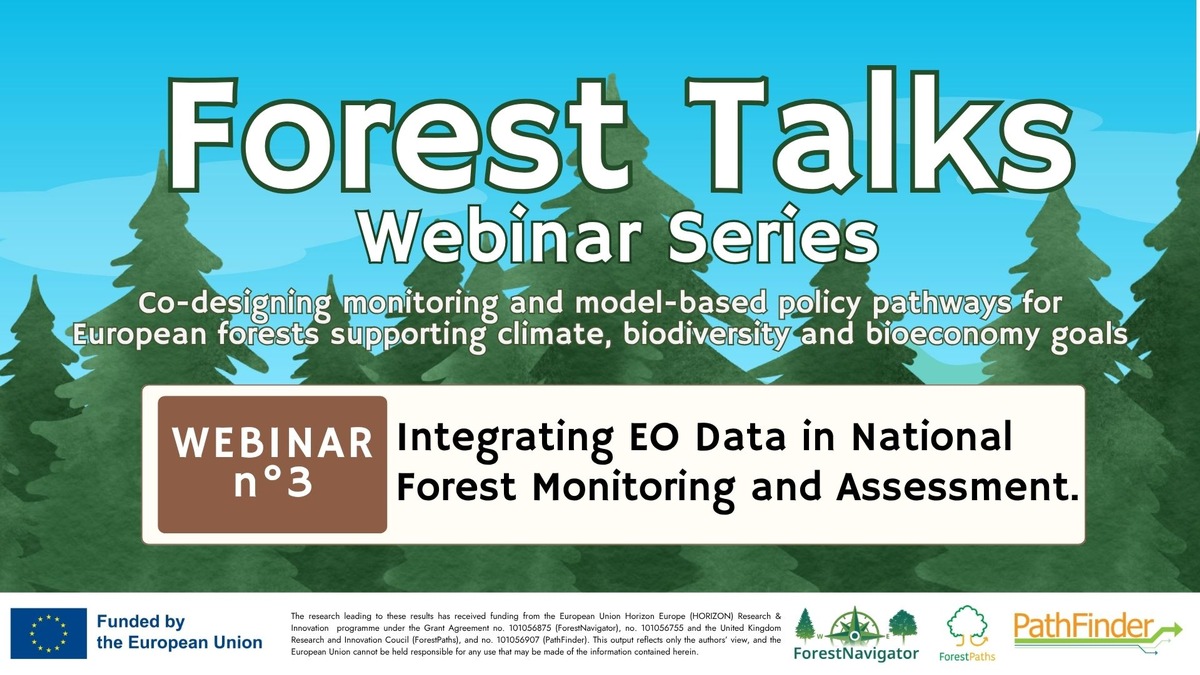
The latest edition of the ForestTalks webinar series, jointly hosted by the ForestNavigator, ForestPaths and PathFinder projects, took place on 23 February 2026 and brought together researchers, modellers, and national reporting experts to discuss advances in Earth observation (EO) for forest monitoring and greenhouse gas inventory support across Europe. The webinar included presentations from Martin Herold, Kevin Black, Roberto Pilli, Emil Cienciala from ForestNavigator, Thomas Pugh from ForestPaths, and Murali Toppil from PathFinder, and covered country-level case studies from Ireland, Italy and the Czech Republic, continental-scale carbon modelling, and a new EU reporting framework currently under development.
Country case studies show varying results
In the first part of the webinar, Martin Herold (GFZ) from the ForestNavigator project talked about how Earth Observation data - such as the European Forest Disturbance Atlas (EFDA), a Landsat-based product providing long-term disturbance records across Europe - can be integrated with National Forest Inventory (NFI) data and national statistics to improve forest monitoring and greenhouse gas reporting. Three country case studies were presented, and while approaches differed, the main conclusion was that no single approach fits all three national contexts.
Kevin Black (FERS) opened with the Irish case, where fragmented forests, small clear-fell patches and persistent cloud cover severely limit the usability of Landsat-based EFDA data. Preliminary Sentinel-1 radar data showed three to seven times greater harvest detection, though this promising result still requires validation. Roberto Pilli presented the case of Italy, where the core challenge is consistency - national harvest statistics differ substantially across sources. Accuracy was improved using an integrated approach based on NFI data, EFDA time series, and regional calibration. Finally, Emil Cienciala (IFER) presented the Czech case, where a historic bark beetle outbreak had driven sanitary logging to five times pre-calamity levels. Despite this exceptional context, EFDA and CBM model estimates showed strong correspondence across 14 NUTS 3 regions once thinning was excluded - an encouraging result for the potential of EO-based monitoring.
Together, the case studies demonstrated both the significant potential and the current limitations of EO-based tools - and the importance of combining them with ground-based data sources.
Continental carbon balance trending toward neutral
Zooming out from the national level, Thomas Pugh (Lund University) from the Forest Paths project presented a continental-scale carbon balance analysis covering 12 EU countries, using the LPJ-GUESS dynamic vegetation model supported by EFDA and NFI data. His results show that the European forest carbon sink has been trending toward neutral over the past decade, with large interannual variability. The 2018 drought reduced productivity across Poland, Germany and southern Sweden; 2020 bark beetle outbreaks hit Germany and the Czech Republic; and 2023 saw elevated respiration in the Nordic zone. While comparison with national LULUCF reporting showed broadly consistent trends, the model captured more interannual variability - suggesting that European forests can no longer be assumed to be a reliable carbon sink and that understanding year-to-year fluctuations will be increasingly important for both climate policy and forest management.
EU Reporting Framework and future forecasts
Murali Toppil (University of Bristol) from the PathFinder project presented work on a harmonised EU reporting framework for the LULUCF sector, designed to convert high-resolution maps and model estimates into a structure consistent with EU policy requirements - and address the inconsistencies that currently make cross-country comparisons difficult. Forecasts across four management scenarios consistently project a decline in above-ground biomass driven by forest maturing, climate impacts and harvesting, with soil carbon showing a steeper decline under more intensive scenarios.
Data and maps are freely available via the PathFinder website and offer a practical foundation for policymakers and researchers working to align forest management with EU climate and biodiversity targets.
Main takeaways
The presentations collectively pointed to a general conclusion: no single data source is sufficient for robust forest carbon monitoring. What the webinar showed is that meaningful progress depends on the integration of NFI field data, EO disturbance products and national statistics - each with their own strengths and limitations. The EFDA remains the most widely applicable long-term disturbance product for Europe, but newer Sentinel-based data offer finer resolution and near-real-time potential, particularly in contexts where Landsat falls short.
All ForestTalks webinar editions, including this one, are on the Forest Paths website. Episodes are also available on YouTube via the PathFinder and ForestNavigator channels.
The research leading to these results has received funding from the European Union’s Horizon Europe Research and Innovation Programme under the Grant Agreement No. 101056875 (ForestNavigator), No. 101056755 (ForestPaths) and No. 101056907 (PathFinder). ForestPaths receives also funding from the United Kingdom Research and Innovation Council (UKRI).
The information and views set out in this press release are those of the author(s) and do not necessarily reflect the official opinion of the European Union. Neither the European Union institutions and bodies nor any person acting on their behalf may be held responsible for the use which may be made of the information contained therein.
PNO Innovation Germany (formerly ARTTIC Innovation) is a one-stop-shop consultancy in public funding and R&I project management as well as communication and stakeholder engagement. We have supported innovative organisations and leading scientists for more than 40 years in navigating the European and national funding ecosystems. PNO Innovation is the reliable partner to work towards improving global health, promoting energy efficiency, safe and clean mobility and aviation, in making societies more resilient, secure, and inclusive and European defence capabilities stronger. An integral part of the PNO Group, we are fully committed to our research clients and partners. We are passionate about their ambitions and help them to innovate and tackle global societal challenges. What unites us all is the desire and ability to innovate sustainably.
We take your privacy seriously. Click here to read our privacy policy. If you no longer wish to receive emails from us, please click below.