
CO₂ to E-Methanol, Aviation Fuels and Speciality Chemicals: Six Nominees Announced for the “Best CO₂ Utilisation 2026” Innovation Award
- Photo Info
- Download
- 2 additional media items
One document
CO2 to E-Methanol, Aviation Fuels and Speciality Chemicals: Six Nominees Announced for the “Best CO2 Utilisation 2026” Innovation Award
Innovative CCU technologies converting CO2 into fuels, chemical building blocks and industrial materials will compete at the CO2-based Fuels and Chemicals Conference 2026
The CO2-based Fuels and Chemicals Conference 2026 taking place in Cologne (Germany) and online on 28-29 April 2026 offers a central stage for technologies that convert CO2 into fuels, chemical intermediates and materials. Six companies that develop unique technologies and materials will compete for the “Best CO2 Utilisation 2026” Innovation Award.
Past nominees and winners of the award have demonstrated diverse applications for CO2-derived products. These range from battery-grade carbon materials and carbon nanotubes to CO2-based polyurethanes for textiles or footwear, and electrochemical routes to methanol fuels. This year’s nominees continue to expand the spectrum with new approaches for converting CO2 into industrial products.
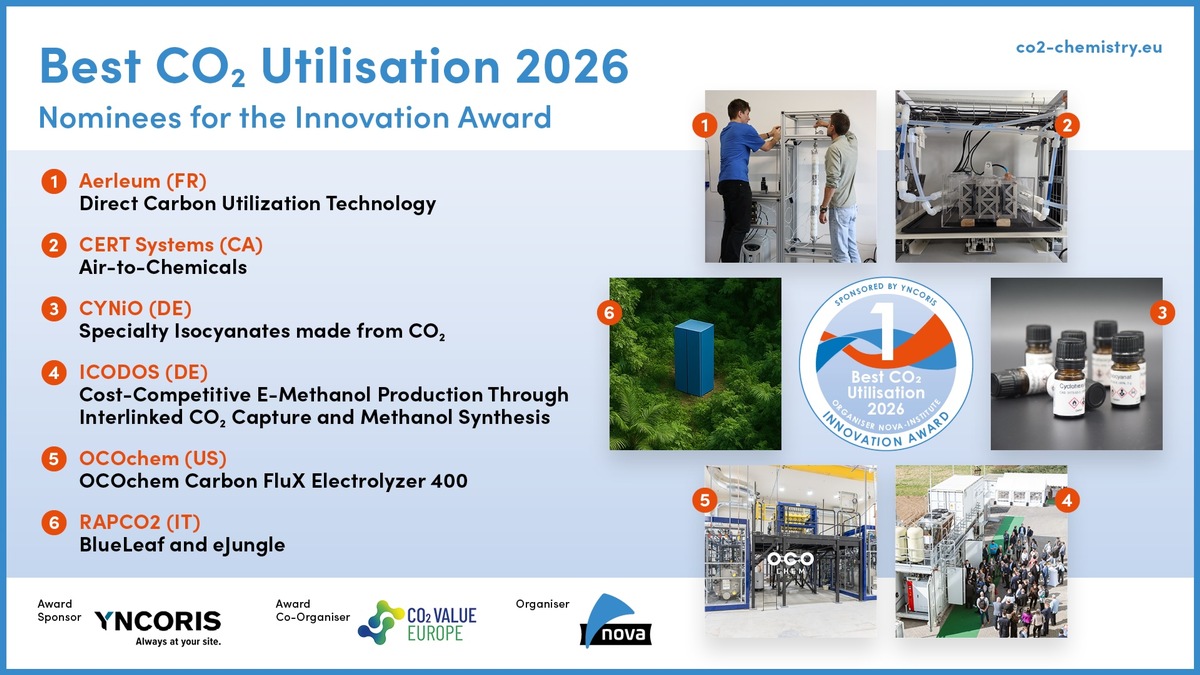
The award honours CO2-based technological and material developments and is co-organised by nova-Institute and CO2 Value Europe, with Yncoris as sponsor. Six nominees will present their unique solutions, while the audience will select the three winners in a live vote.
Technologies converting CO2 into fuels and chemicals
The nominated solutions showcase different technical routes for industrial CO2 use, from electrochemical conversion and integrated capture-and-synthesis processes to direct air capture systems linked with chemical production
Aerleum (FR) – Direct Carbon Utilisation Technology
Aerleum’s Direct Carbon Utilisation technology enables the direct conversion of atmospheric or industrial CO2 into valuable commodities such as fuels and chemicals. This integrated and patented technology is designed for scalable industrial deployment, delivering carbon-neutral products at competitive cost.The first application is e-methanol, a versatile low-carbon fuel and chemical feedstock that can be used primarily in aviation (converted into jet fuel) and in maritime shipping (as a drop-in fuel). Beyond mobility, e-methanol also provides a sustainable building block for the chemical industry, enabling the production of everyday goods with a lower carbon footprint. By targeting hard-to-abate sectors, Aerleum offers a practical, scalable, and high-impact pathway to decarbonisation.
CERT Systems (CA) – Air to Chemicals
CERT Systems is producing drop-in, low-carbon materials and fuels such as Sustainable Aviation Fuel (SAF). Through an Air-to-Chemicals process, atmospheric CO2 is captured and converted into ethylene in a single integrated system. By directly converting the CO2 captured in solution, CERT avoids the costly regeneration step needed to produce pure CO2.
CERT's process generates ethylene from CO2, a high-value molecule that is primarily used in the production of plastics. However, clean ethylene is a key intermediate for the production of SAF. CERT's Air-to-Chemicals process enables the production of eSAF with low carbon intensity and low cost of carbon abatement.
CYNio (DE) - Specialty Isocyanates made from CO2
Today, only a few isocyanates are available – mostly standard products like Methylenediphenyl diisocyanate (MDI) or Toluene diisocyanate (TDI). But research and industry urgently need more diversity to drive innovation. This is where CYNiO comes in: a spin-off from the TU Bergakademie Freiberg, developing a unique CO2-based process that enables safe, more sustainable, and flexible production of specialised isocyanates. For this, CYNiO uses CO2 instead of the highly toxic gas phosgene to produce isocyanates that are currently unavailable and difficult to obtain on the European market. However, they are essential for modifying products of a wide range (e.g. adhesives, coatings, & pharmaceuticals). The goal is to make isocyanates accessible, reliable, and tailored to specific needs, helping innovations to develop faster from idea to impact.
ICODOS (DE) – Cost-Competitive E-Methanol Production Through Interlinked CO2 Capture and Methanol Synthesis
ICODOS has developed a globally unique, end-to-end, breakthrough technology for economical e-methanol production, that rests on three pillars: First, a patented hybrid process that merges CO2 capture and methanol synthesis, cutting energy demand by more than 70 % compared to state-of-the-art alternatives and achieving >95 % CO2 utilisation. Second, a dynamic operation that allows direct use of the lowest-cost, intermittent solar and wind electricity. And third, a modular plant design with prefabricated, transportable units, compressing project execution time to <3 years. Together, these innovations enable levelised production costs up to 48 % lower compared to today’s available technologies while also enabling to tap into Europe’s vast pool of distributed, stranded biogenic CO2 point sources.
OCOchem (US) – OCOchem FluX Electrolyzer 400
The OCOchem Carbon FluX Electrolyzer (CFX) 400 electrocatalytically regenerates captured carbon dioxide and water into sustainable formic acid or potassium formate. The CFX 400 employs a stack of 4 industrial-scale CO2 electrolyzer cells using OCOchem in-house fabricated Axial FluX Gas Diffusion Electrodes that are each 15,000 cm2 in size, over 6 times larger than previously reported. The modular factory-fabricated system was deployed and commissioned in 6 weeks, produces 60 tons/year, operates at 85 % Faradaic Efficiency with a high current density (250 mA/cm2) and has a demonstrated Axial FluX Gas Diffusion Electrode durability of over 1200 hours. The first commercially available carbon-negative formates began shipping in October 2025 to 5 different customers.
RAPCO2 (IT) – BlueLeaf and eJungle
RAPCO2 brings two indoor Direct Air Capture (DAC) products to the market: the first is BlueLeaf, equivalent to one hectare of forest capable of capturing the CO2 produced in small shops or offices; the second is eJungle, a sort of jungle 2.0, equivalent to 80 BlueLeaf combined, which instead returns an intrinsically safe chemical product (sodium acetate). The CO2 captured by BlueLeaf and eJungle is converted into acetate through a patented bioreactor, which is able to regenerate the DAC material at very low energy demand. Acetate collected is then processed in the main plant, which through a ketonisation-hydrogenation steps to isopropyl alcohol (IPA). IPA is a safe, non-toxic eFuel, with a higher calorific value than others (e.g., methanol) and with greater potential for applications.
The CCU and Power-to-X Community Hub
The conference program addresses the shift of CCU technologies from pilot projects to industrial deployment. Speakers explore how integrated capture and conversion concepts can operate under real market conditions, which business models support investment, and which regulatory frameworks influence project development. Additional sessions cover renewable hydrogen availability, identification and use of reliable CO2 sources (especially biogenic streams), as well as certification and sustainability assessment methods for CO2-based products.
Each year, the CO2-based Fuels and Chemicals Conference brings together over 230 international experts from industry, research and policy for presentations, poster sessions and networking opportunities for stakeholders along the entire CCU and Power-to-X value chain.
The CO2-based Fuels and Chemicals Conference 2026 is supported by event sponsors GIG Karasek and Holcim. Mona Neubaur, Minister for Economic Affairs, Industry, Climate Protection and Energy of the State of North Rhine-Westphalia has once again taken on the patronage of the conference.
The full programme and registration are available at: https://co2-chemistry.eu
Find all nova press releases, images and more free-for-press material at https://nova-institute.eu/news/pr/
Responsible for the content under German press law (V. i. S. d. P.):
Dr. Lars Börger (CEO)
nova-Institut für politische und ökologische Innovation GmbH
Leyboldstraße 16
50354 Hürth
Germany
Tel: +49 2233 460 14 00
Fax +49 2233 460 14 01
 contact@nova-institut.de
Since the mid-1990s, the nova-Institute has been dedicated to sustainability and today focuses primarily on renewable carbon cycles. As an independent research institute, it supports companies – particularly from the chemical, plastics, and materials industries – in the use of renewable carbon derived from biomass, direct CO₂ utilisation (CCU), and recycling.
With a multidisciplinary team of scientists, the nova-Institute participates in international innovation projects and provides science-based management consulting. The institute follows a holistic approach: its experts analyse which technologies and raw materials are suitable for specific products, in which markets their application is feasible, which regulatory frameworks apply, how sustainable the solutions are, and how they can be successfully positioned in the market.
Based on these analyses, the team develops tailored strategies to support the transformation from fossil to renewable carbon. Around 50 experts from various disciplines work together to drive the defossilisation of industry – for a climate-neutral future.
More information: www.nova-institute.eu – www.renewable-carbon.eu
Subscribe to our newsletter:  https://renewable-carbon.eu/newsletters
Comprehensive reports and free graphics available at:  https://renewable-carbon.eu/publications